
What Is Backstitch in Cross Stitch?
Backstitch is a line stitch worked on top of finished cross stitch to add outlines and fine detail. Unlike a cross stitch, which fills one square of the fabric grid, backstitch runs along the edges of squares in a continuous line — around a cat’s face, along a flower stem, through lettering. It is worked last, after all the crosses are done.
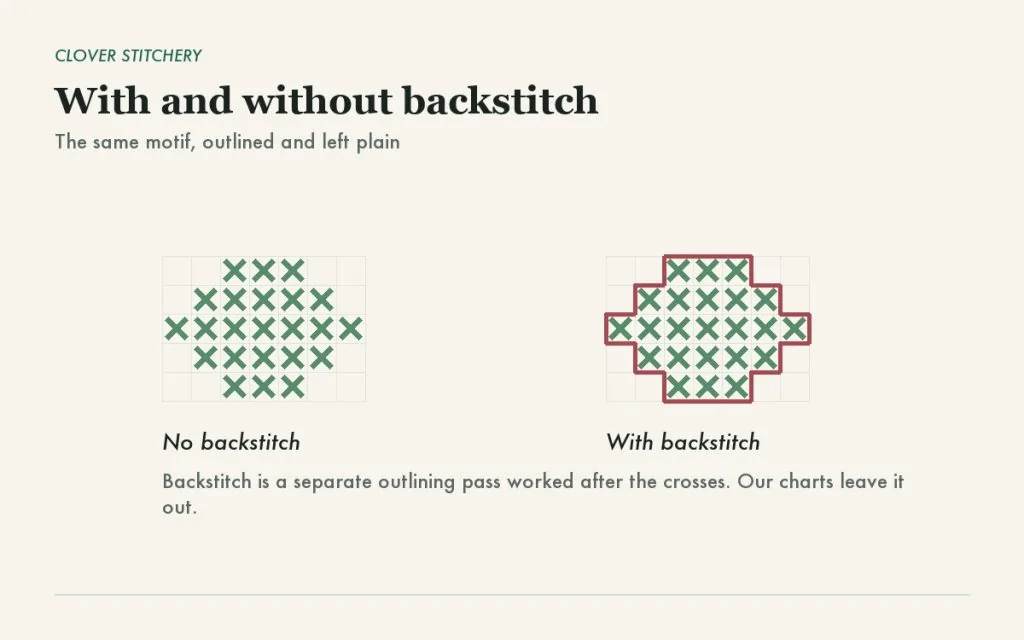
That is the short answer. The longer answer is why it matters when you are choosing a pattern, because backstitch is the single most common reason a cross-stitch project gets abandoned in a drawer.
What backstitch actually does to a design
Cross stitch builds an image out of squares. Squares are excellent at colour and mass, and poor at thin lines. A whisker, an eyelid, the outline of a leaf against a similar green — none of these survive being rendered as full squares. Backstitch solves that by drawing a line that ignores the grid.
The result is sharper and more illustrative. A face charted without backstitch reads as a soft block of colour; the same face with backstitch reads as a face. This is why so many designs use it, and why it is genuinely good at what it does. The charts here go the other way and leave it out — Halloween Ghost with Pumpkin is eight colours of whole crosses with no outlining pass at the end.
Why it is where projects stall
Backstitch changes the nature of the work. Cross stitch is rhythmic and forgiving — you count, you stitch, you look up at the television. Backstitch is precise line work. You are following a drawn path across the chart, deciding where each line starts and stops, often over stitches you have already finished and do not want to distort.
It also arrives at the worst possible moment. You reach it after twenty or thirty hours of stitching, when the piece is nearly finished and you badly want to be done. Instead there is a new, slower, fussier task standing between you and the end. A great many pieces reach exactly that point and stop there.
None of this makes backstitch bad. It makes it a cost, and a cost worth knowing about before you buy rather than after.
How to tell whether a chart uses backstitch before you buy
Listings do not always say plainly. Here is what to look for:
| Signal on the listing | What it usually means |
|---|---|
| “Full cross stitch only” or “whole stitches only” | No backstitch, no fractional stitches. The safest wording. |
| A separate line in the thread list marked “backstitch” or “BS” | Backstitch is required, usually in one dark colour. |
| Symbols shown as lines rather than squares in the key | Those lines are backstitch. |
| “Includes French knots” | A different extra stitch, but the same kind of finishing work. |
| Nothing stated at all | Assume it may be there and ask the designer. |
The finished-look preview is the other reliable tell. Look closely at outlines and faces: crisp thin dark lines that do not follow the square grid are backstitch.
Can you just skip it?
Yes, and stitchers do it all the time. Nothing breaks. The piece will read softer and less defined, which on some designs looks perfectly good and on others looks unfinished — a face without backstitch can lose its expression entirely.
If you want to try skipping it, stitch all the crosses first, then hold the piece at arm’s length before deciding. Many designs look better than expected without their outlines. Some clearly do not, and then you have lost nothing by looking.
A middle path also exists: add backstitch only where it earns its place. Outline the face and leave the foliage alone. Nobody is checking.
Patterns designed without it from the start
Skipping backstitch on a chart that expects it is a compromise. A chart designed without backstitch is a different thing: the colours, contrast and shapes are chosen so the image works with squares alone, and no outline is needed to hold it together.
That is how almost everything in this shop is charted. Sixteen of our seventeen patterns use whole cross stitches only — no backstitch, no fractional stitches, no French knots. You can browse those in cross stitch patterns without backstitch, or start with the beginner range if this is your first project.
Common questions
Is backstitch harder than cross stitch?
Not technically — the stitch itself is simple. It is harder to do neatly, because mistakes in a line are more visible than mistakes in a block of colour.
How many strands of floss do I use for backstitch?
Usually one, sometimes two for a bolder outline, against the two strands most charts use for the crosses. Fewer strands keep the line fine.
Do beginners need to learn backstitch?
Eventually it is worth knowing, and it takes about ten minutes to learn. For a first project, a design that does not need it removes one thing that can go wrong.
Does no backstitch mean the pattern is simpler?
Not necessarily. A no-backstitch chart can still have thirty colours and take fifty hours. It means one type of work is absent, not that the project is small.
If you would rather leave outlines for later, every chart in the no backstitch collection uses whole crosses only. When you do come to add them, the strand count guide covers how many strands keep the line fine.