
How Much Fabric Do You Need for Cross Stitch?
Take the stitch count of the design, divide it by your fabric count, then add six inches to each dimension. That is the whole calculation. A 110 × 110 design on 14 count aida needs 110 ÷ 14 = 7.9 inches of stitched area, plus six inches of margin, so you buy a piece at least 14 × 14 inches.
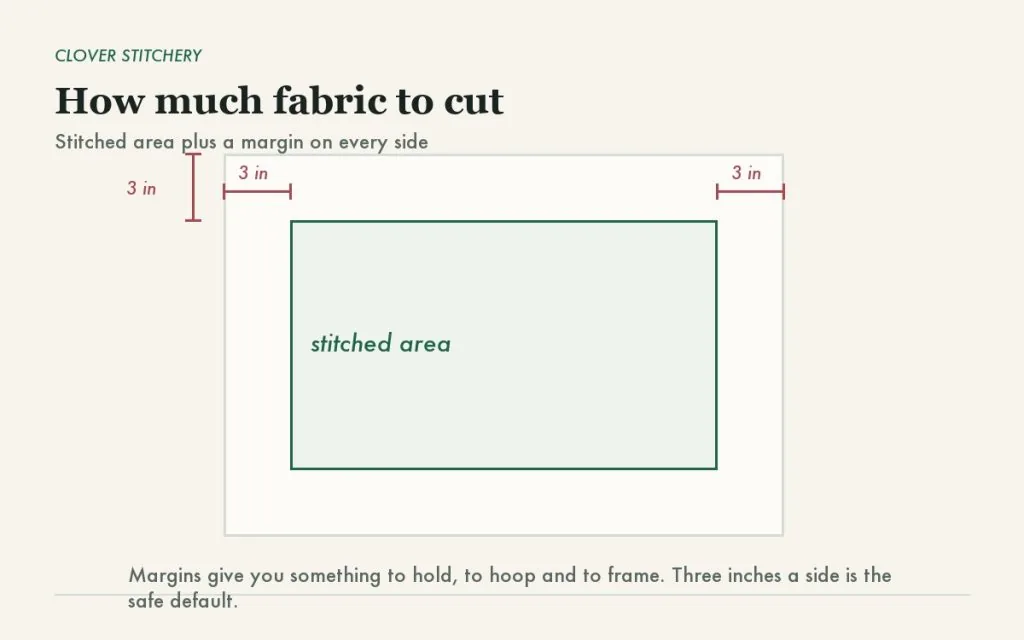
Round the result up to the next whole inch, never down: being an eighth of an inch short is the same as being three inches short. Every figure in the tables below is rounded that way.
The six inches is three inches of spare fabric on every side. It feels generous when you are cutting and it is exactly right when you come to frame the piece, because a hoop needs fabric to grip and a frame needs fabric to fold around the board.
Working through a real example
Take our Lucky Four-Leaf Clover, charted at 110 × 110 stitches.
| Fabric | Stitched area | Fabric to buy |
|---|---|---|
| 11 count aida | 10.0 × 10.0 in | 16 × 16 in |
| 14 count aida | 7.9 × 7.9 in | 14 × 14 in |
| 16 count aida | 6.9 × 6.9 in | 13 × 13 in |
| 18 count aida | 6.1 × 6.1 in | 13 × 13 in |
Notice that the fabric you buy barely changes between 16 and 18 count, because the margin dominates. On small designs you are mostly buying margin, not stitched area — which is why tiny patterns rarely need tiny fabric. A tall chart changes that: Cute Baby Vampire with Pumpkin is 110 × 164, so the height rather than the margin decides what you buy.
The same maths on a large design
Little Fawn in Blue Flowers is charted at 180 × 251 stitches, one of the biggest designs we sell.
| Fabric | Stitched area | Fabric to buy |
|---|---|---|
| 14 count aida | 12.9 × 17.9 in | 19 × 24 in |
| 16 count aida | 11.3 × 15.7 in | 18 × 22 in |
| 18 count aida | 10.0 × 13.9 in | 16 × 20 in |
Here the count genuinely matters. Moving from 14 to 18 saves three to four inches in each direction, which can be the difference between a standard pre-cut piece and having to buy from the roll.
Why fabric count changes the size and nothing else
Fabric count is the number of stitches per inch. On 14 count aida you fit fourteen crosses into an inch; on 18 count you fit eighteen into the same inch. The chart does not change — the same 110 × 110 grid — but each stitch is smaller, so the finished piece is smaller.
Higher counts mean finer work and smaller holes. Most stitchers find 14 count comfortable, 16 count a small step up, and 18 count the point where good light starts to matter.
If you are working in centimetres
Divide the stitch count by the fabric count to get inches, then multiply by 2.54. For margin, add 15 cm to each dimension rather than six inches — it is very slightly more, which is the right direction to err in.
Mistakes worth avoiding
- Cutting the margin to save fabric. Two inches of spare feels sufficient and is not: hoops need something to hold, and framing eats the rest. Three inches per side is the working minimum.
- Forgetting that aida frays. Whipstitch or tape the raw edges before you start, or the margin you measured will shrink as you handle the piece.
- Assuming pre-cut sizes fit. A standard pre-cut is often 12 × 18 inches. Check your calculated size against the actual piece before buying.
- Using the finished size on the listing as the fabric size. The finished size is the stitched area only. The margin is on top of it.
Where to find the numbers
Every listing in this shop states the stitch count, so you can run this calculation before you pay rather than after the fabric arrives. If you would rather start with something small while you get a feel for the maths, the small and mini patterns all fit comfortably on a single pre-cut piece.
Common questions
Does the fabric colour change the size?
No. Count is a property of the weave, not the colour.
What if my design is not square?
Run the calculation separately for width and height. The margin is the same six inches in each direction.
Can I use evenweave or linen instead of aida?
Yes, but those are usually stitched over two threads, so a 28 count evenweave behaves like 14 count aida. Halve the count, then use the same formula.
How much extra should I allow for a hoop?
The standard three inches per side covers a hoop. If you plan to leave the piece in a large display hoop permanently, measure the hoop and add an inch beyond its outer edge.
If you would rather work back from a finished size you already have in mind, Aida count and finished size does that calculation. For thread, how many skeins you need uses the same approach.