
The Confetti Index: Measuring How Tedious a Cross Stitch Chart Will Be
Difficulty labels on cross stitch patterns are decoration. Beginner, intermediate, advanced — nobody agrees what they mean, and the person who wrote the label was the person selling you the chart.
Meanwhile the thing that actually decides whether a project is a pleasure or a slog goes unmeasured. So here is a number for it, the arithmetic behind it, and every pattern in this shop scored against it — including the four that come out badly.
The thing nobody puts a number on
Confetti is what stitchers call single stitches of a colour scattered across a design, never touching another stitch of the same shade. A conversion algorithm produces them by the hundred, because a photograph has thousands of subtly different pixels and the algorithm’s job is to match the picture, not to make something pleasant to stitch.
Each stray stitch costs you the same as a solid block of forty: find the position, thread the needle, secure the tail, make the cross, secure the tail again. Then you look at the fabric and cannot see that anything changed.
That is where projects die. Not at the hard part — at the boring part. And nothing on a typical listing warns you it is coming.
The calculation
Take the chart’s grid — width in stitches multiplied by height in stitches. Divide by the number of colours. That’s it. Simple Sun is 80 × 80 with one colour, so it scores 6,400. Spring Tulip Bouquet is 180 × 209 with thirty-five, so it scores about 1,075.
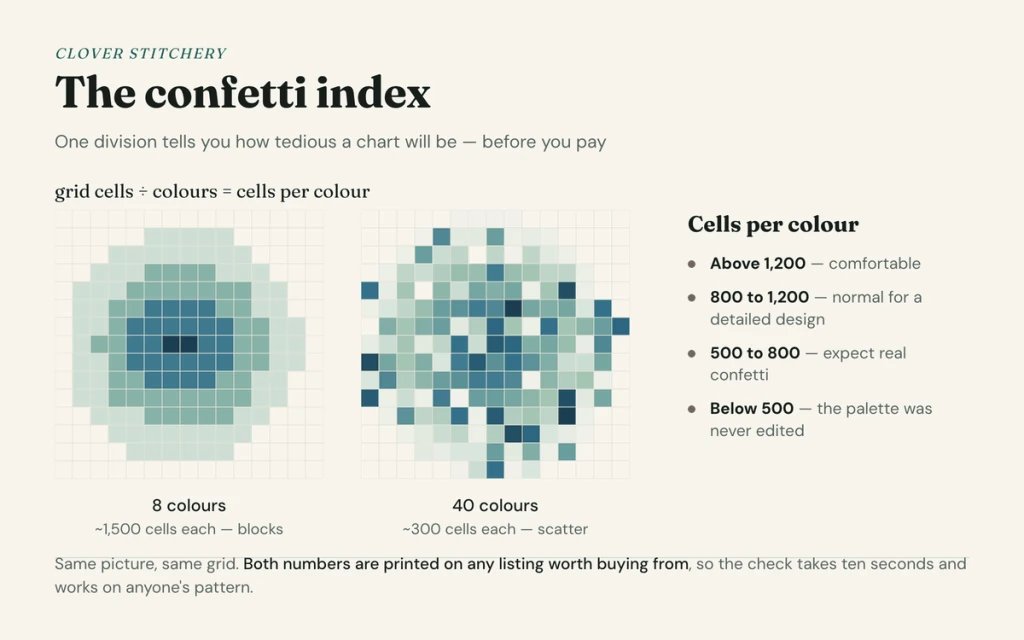
Grid cells ÷ colours = cells per colour.
A 110 × 110 chart is 12,100 cells. In eight colours that’s about 1,500 cells each — enough for every colour to form real shapes. Split the same grid between 40 colours and each one gets 300, which is not a shape. It is scatter.
Both numbers are printed on any listing worth buying from, so you can run this before you pay, on anyone’s pattern, in about ten seconds.
What the numbers mean
- Above 1,200 — comfortable. Colours form blocks you can stitch in runs.
- 800 to 1,200 — normal for a detailed design. Some fiddly passages, nothing unreasonable.
- 500 to 800 — expect real confetti. Fine if the design earns it; irritating if it doesn’t.
- Below 500 — the palette was almost certainly never edited after conversion.
Every pattern in this shop, measured
Sorted worst first, because that is the half worth seeing.
| Pattern | Grid | Colours | Cells per colour |
|---|---|---|---|
| Moonlit Owl | 110 × 105 | 22 | 525 |
| American Eagle Flag | 110 × 120 | 22 | 600 |
| Spring Duckling | 110 × 110 | 18 | 672 |
| Colorful Apple Tree | 110 × 105 | 15 | 770 |
| Scary Halloween Pumpkin | 110 × 146 | 19 | 845 |
| Flowering Cactus | 110 × 172 | 20 | 946 |
| Delicate Pink Rose | 140 × 138 | 18 | 1,073 |
| Spring Tulip Bouquet | 180 × 209 | 35 | 1,075 |
| Pink-Haired Witch | 110 × 181 | 17 | 1,171 |
| Moonlit Cat Couple | 110 × 140 | 13 | 1,185 |
| Red and White Lighthouse | 110 × 137 | 12 | 1,256 |
| Little Fawn in Blue Flowers | 180 × 251 | 32 | 1,412 |
| Golden Mona Lisa | 90 × 117 | 7 | 1,504 |
| Halloween Ghost with Pumpkin | 110 × 110 | 8 | 1,512 |
| Lucky Four-Leaf Clover | 110 × 110 | 8 | 1,512 |
| Man of Sorrows Jesus Portrait | 140 × 210 | 15 | 1,960 |
| Crowned with Thorns Jesus | 180 × 240 | 16 | 2,700 |
| Sunrise Over Water | 80 × 80 | 2 | 3,200 |
| Red Flower and Bee | 160 × 230 | 11 | 3,345 |
| Simple Sun | 80 × 80 | 1 | 6,400 |
| Simple House | 110 × 90 | 1 | 9,900 |
The median across the shop is 1,256. Four patterns sit below 800.
About those four
Moonlit Owl at 525 is the weakest number here. Twenty-two colours on a small grid, and the reason is plumage — feather shading is the one subject where dropping shades really does flatten the result. I would still stitch it. But 525 tells you honestly that there will be fiddly passages, and no difficulty label was ever going to tell you that.
American Eagle Flag at 600 has less of an excuse. Some of those twenty-two colours are doing very little work, and it is on the list to be re-cut with a merged palette.
Spring Duckling at 672 and Colorful Apple Tree at 770 sit in the grey band. Both are cheerful, simple-looking designs where a stitcher would reasonably expect an easier ride than the numbers suggest.
Publishing this is uncomfortable, which is rather the point. A number you only quote when it flatters you isn’t a measurement, it’s marketing.
What this number does not tell you
Being straight about the limits, because a metric oversold is worse than none:
It uses the grid, not the stitched area. Most designs leave fabric unstitched around the subject, so the real figure per colour is lower than the table shows — often by a third or more. Use it to compare charts with each other, not as an absolute count.
It says nothing about where the colours sit. Twenty colours arranged in clean bands stitch beautifully. The same twenty sprinkled evenly are miserable. Two identical scores can feel completely different at the fabric.
It ignores backstitch entirely. A chart can score wonderfully and still hide three evenings of outlining. Backstitch is worth understanding separately, and if you would rather not deal with it at all, some designs skip it by construction.
Low is not automatically bad. Portraits and anything with fur, feathers or water genuinely need their shades. The number is a question to ask, not a verdict.
Using it on somebody else’s listing
The calculation works on any pattern, from any shop, which is the useful part.
If a listing gives you the grid and the colour count, do the division. If it gives neither — and a surprising number of them give neither — that absence is its own answer. Nobody hides four harmless numbers by accident.
One more check once you have the thread list in hand: scan for the same DMC number appearing twice under two different symbols. Generated charts do this often, each entry carries its own skein estimate, and you end up buying two skeins of something you needed one of. Working out skeins properly takes five minutes and saves more than that in floss.
Why bother
Because “beginner friendly” is an opinion and 1,512 is a fact.
Every pattern in this shop states its grid, its colour count, its stitch types and its finished size before you pay, and now it states this too. Run the division on whatever you are about to buy — here or anywhere else. If the answer is uncomfortable, you have learned something for free.
The free patterns are a reasonable place to test the method, and the finished-size arithmetic pairs with it if you are working out what a chart will actually become.